Survive 7 Days In Desert Day-by-Day Survival Walkthrough
A seven-day plan from first palm chop to the camel that saves you.
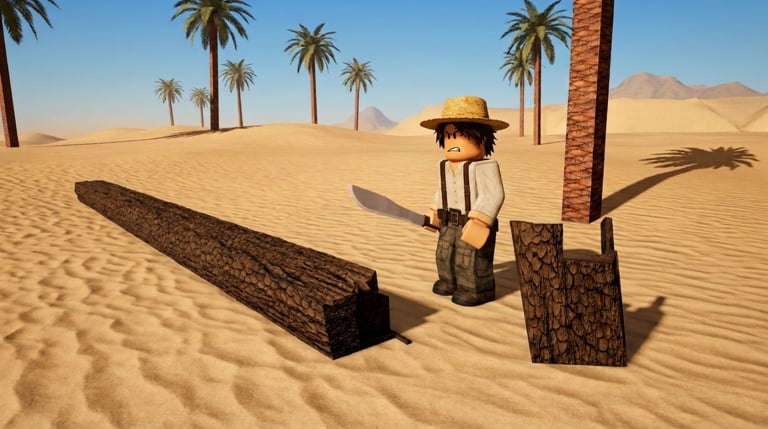
Survive 7 Days In Desert is literally paced by a week. The fantasy is not an endless sandbox afternoon—it is a countdown toward a camel rescue on Day 7, powered by chopping palms, building camp, purifying water, and surviving heat. This walkthrough turns that fantasy into a practical calendar you can follow on Roblox servers with up to 25 players, whether you solo a tight loop or share roles with a group.
Use this page as your spine. When a single system needs depth, branch to Getting Started, Survive Heat, Purify Water, Build Camp, and Camel Rescue. Christos Studios is still updating the experience, so treat daily goals as priorities rather than scripted button sequences.
How to read this calendar
Each day lists a primary objective, supporting chores, and a failure warning. If you fall behind, do not skip ahead to decorative goals—recover the missing pillar first. The desert among rocky mountains, cactus, palm groves, and oasis water rewards boring consistency.
Day 1 — Foundation
Primary objective: Establish a livable camp core and a known water route.
Chop palms early, place tent and campfire, and walk the oasis path until it is memorable. Complete at least one full purify cycle. Practice one clean heat cycle: work, return, recover. Do not climb every ridge.
Supporting chores: landmark naming, small wood buffer, confirm camp is not absurdly far from resources.
Failure warning: sightseeing before shelter. Day 1 deaths from curiosity are common and avoidable.
Day 2 — Stabilize the loop
Primary objective: Make wood → camp → water → heat recovery feel automatic.
Repeat short loops until you can perform them under mild pressure. Expand camp only if expansion shortens chores (staging space, clearer access). Avoid mansion planning.
Supporting chores: second purify buffer, re-check heat return timing, tidy pathing around tents and fire.
Failure warning: spending the entire palm surplus on style while water remains hand-to-mouth.
Day 3 — Efficiency upgrades
Primary objective: Reduce commute tax.
If loops still feel long, relocate or reshape camp now—mid-week moves hurt more later. Optimize approach paths to palms and oasis. On full servers, identify quieter resource nodes.
Supporting chores: role talk with teammates if present (cutter, runner, builder), reinforce heat micro-breaks, confirm buffers before any scouting.
Failure warning: “quick” exploration that turns into a lost, overheated detour.
Day 4 — Mid-week audit
Primary objective: Audit all four pillars honestly.
Ask: Is wood income reliable? Is camp actually used for recovery? Is purification scheduled? Are heat phases respected? Fix the weakest pillar before adding new projects. This is the best day to prune clutter from camp.
Supporting chores: restock buffers, repair priorities, map one alternate oasis approach.
Failure warning: assuming early success means the week is already won. Mid-week complacency creates Day 6 crises.
Day 5 — Controlled expansion or discipline
Primary objective: Only expand if Days 1–4 loops are stable; otherwise enter discipline mode.
Stable groups may add coop comfort—extra tent capacity or clearer staging. Unstable runs should freeze builds and grind buffers. Heat and water mistakes on Day 5 cascade into the finish.
Supporting chores: practice danger-phase returns, keep fire and tent core unobstructed, avoid contested hero plays.
Failure warning: starting a large renovation you cannot finish before Day 7.
Day 6 — Protect the lead
Primary objective: Conservation.
Stop inventing new goals. Maintain purified water margins, keep heat recoveries crisp, and treat every outdoor trip as optional unless it refills a real shortage. Camp should already be “good enough.” Read ahead in Camel Rescue on Day 7 so tomorrow is execution, not brainstorming.
Supporting chores: quiet wood top-up if needed, clear junk that blocks tent access, agree on group rally rules.
Failure warning: gambling on long ridge tours because you “feel safe.”
Day 7 — Earn the camel
Primary objective: Stay alive and stable until the camel rescue resolves the week.
Play small. Prefer camp proximity. Run water only to maintain buffers. Respect heat hard limits. Do not demolish and rebuild. The published win fantasy is survival until the camel saves you—not a final boss arena of your own making.
Supporting chores: keep teammates oriented to the core camp, call heat danger early, skip contested chaos unless survival requires it.
Failure warning: dying to greed minutes before the finish after six days of good habits.
Solo versus group pacing
Solo players should interpret every “expansion” line as optional. Your win is a tight machine: small camp, strict purify schedule, strict heat returns. Groups can parallelize Day 2–4 chores but must still share one calendar—do not let half the team live on Day 2 goals while the other half pretends it is Day 6.
Recovery templates when you fall behind
- Behind on camp: pause exploration; rebuild core; shorten site distance.
- Behind on water: emergency schedule of purify loops; cut builds.
- Behind on heat discipline: mandatory micro-break rule for the next five cycles.
- Behind on wood: targeted palm runs with hard return timers; no side quests.
Falling behind is normal in a work-in-progress survival game. What matters is correcting toward Day 7 instead of rage-wandering the dunes.
After the week
Whether you succeed or wipe, review which day broke. Then reread the specialist guide for that break. Check Updates if a patch changed feel, skim Codes only if rewards exist later, and return to the Guides Hub for the full map. A clean day-by-day rhythm is the difference between a desert story and a desert screenshot collection.
Frequently Asked Questions
Quick answers to the most common desert survival questions.
What is the most important day for beginners?
Day 1–2. If camp, water routing, and heat cycles are not stable early, later days become constant emergency response.
Can I explore the mountains on Day 1?
Only after a tent-and-fire core and a known purify route exist. Early sightseeing is a common wipe pattern.
When should I stop building new structures?
Freeze major expansions by Day 6. Late-week play should protect buffers for the camel rescue, not redesign the base.
How do full servers change the schedule?
Expect contested palms and oasis traffic. Shift earlier to quieter nodes and keep larger purified buffers so you can wait out crowds.
What if I skip a day plan after a death?
Resume at the pillar you lost—camp, water, heat, or wood—using the recovery templates instead of pretending you are still on schedule.
Does Day 7 require a special item beyond surviving?
The published fantasy is lasting until the camel saves you. Prioritize stability and uptime over last-minute experimental projects.